


- 102 Views
- 9 Min Read
- (0) Comment
Hadzabe Tribe Tanzania: Life, Culture, Hunting & Way of Life Explained

The Hadzabe live around Lake Eyasi in northern Tanzania, particularly in the Yaeda Valley between the Ngorongoro Highlands and the Serengeti ecosystem. This region of the Great Rift Valley provides the woodlands, grasslands, and natural resources that have supported the Hadzabe’s traditional hunter-gatherer lifestyle for generations. Many Hadzabe communities continue to live within their ancestral homeland, where they hunt wild game, gather honey, fruits, and tubers, and maintain a close connection with the natural environment.
Who Are the Hadzabe?

The Hadzabe are an indigenous hunter-gatherer people who live around Lake Eyasi in northern Tanzania. They are considered one of the last remaining hunter-gatherer communities in Africa, relying largely on hunting wild animals and gathering fruits, berries, honey, and other natural foods from the land. Unlike many neighboring communities, the Hadzabe traditionally do not practice large-scale farming or livestock keeping.
The Hadzabe are known for maintaining a way of life that reflects some of the earliest forms of human survival. Their deep knowledge of wildlife, tracking skills, and close relationship with nature have made them one of Tanzania’s most fascinating cultural groups and an important part of the country’s cultural heritage.
Why the Hadzabe Are Not Living in the Past

When people first encounter the Hadzabe bushmen, it is easy to assume that they represent a way of life that has been left behind by modern civilization. However, this assumption does not fully capture the reality of their existence. The Hadzabe are not living in the past; they are living with a different understanding of what is necessary for life.
In their world, happiness is not measured by how much one owns or accumulates, but by how well one adapts to nature, how strongly one connects with others, and how effectively one lives within the present moment. There is no constant pressure to build more, store more, or achieve more in a material sense. Instead, life moves with a rhythm shaped by the environment itself.
This contrast raises an uncomfortable but important question for modern readers: if life has become more advanced, why has peace of mind not become easier to find?
How do they survive as hunter-gatherers?

The Hadzabe survive as hunter-gatherers by obtaining most of their food directly from the natural environment. Rather than relying on farms, livestock, or stores, they hunt wild animals, gather fruits, berries, and tubers, and collect honey from the surrounding woodlands of northern Tanzania.
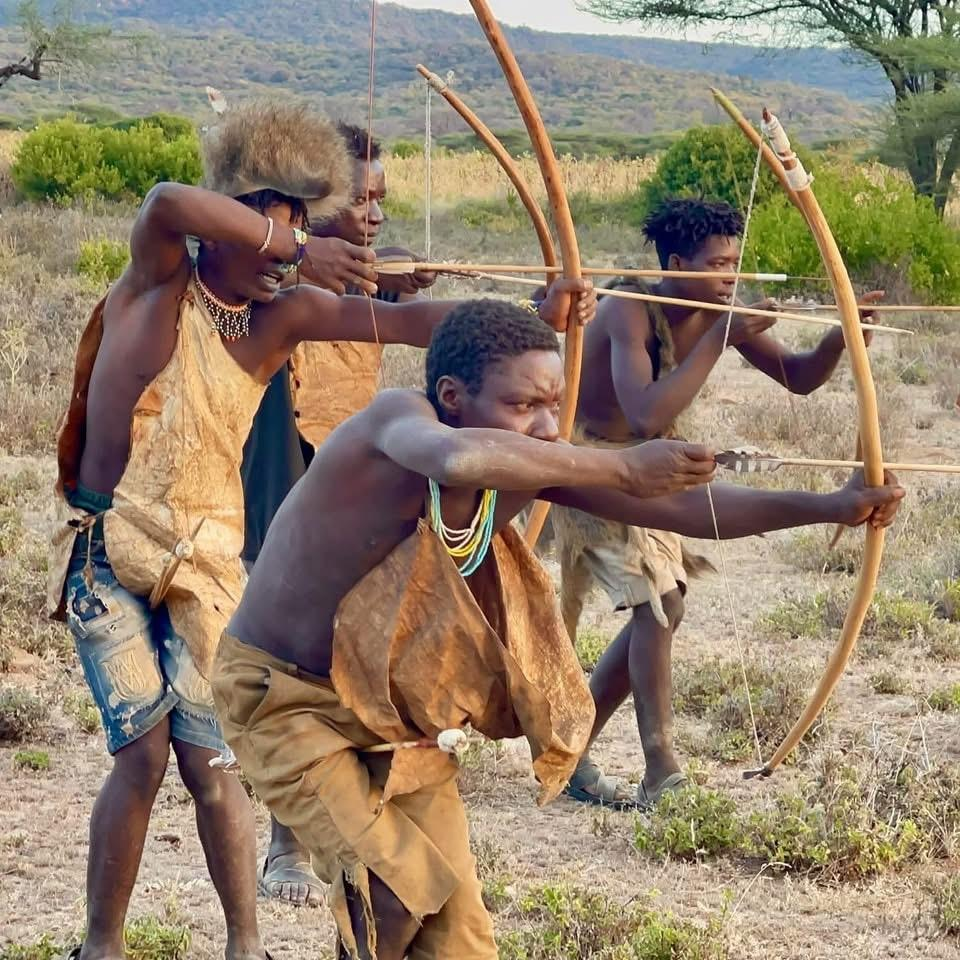
Hunting is traditionally carried out using bows and poison-tipped arrows, with hunters relying on exceptional tracking skills passed down through generations. They can identify animal movements from footprints, broken branches, and other subtle signs that many people would never notice. Honey is also a highly valued food source, and Hadzabe hunters often work with honeyguide birds, which lead them to wild beehives hidden in trees and rocky areas.
Women typically gather edible plants, berries, baobab fruit, and underground tubers, providing an important and reliable source of nutrition throughout the year. Because food availability changes with the seasons, the Hadzabe adapt their movements and daily activities to the rhythms of nature, using their deep knowledge of the land to find resources when and where they are needed.
This way of life has allowed the Hadzabe to thrive in the Lake Eyasi region for generations while maintaining a close relationship with the environment that supports them.
Hadzabe Hunting: Skill, Awareness, and Connection to Nature
Hadzabe hunting is one of the most fascinating aspects of their way of life, not because it is aggressive or dramatic, but because of the level of awareness it requires. Hunting is done with handmade bows and arrows, but the real skill lies not in the tools themselves but in the deep understanding of nature that guides their use.
Hunters must read footprints, understand animal behavior, follow subtle signs in the environment, and move with patience and silence. Every movement is intentional, and every decision is based on knowledge gained through experience rather than written instruction.
Unlike modern systems where food is purchased and available on demand, Hadzabe hunting reflects a direct relationship between humans and the natural world. Food is not something simply acquired—it is something understood, tracked, and respectfully taken when needed.
What language do they speak?

The Hadzabe speak Hadzane, a unique language that is unlike the Bantu languages spoken by most communities in Tanzania. One of its most distinctive features is the use of click sounds, which often surprise first-time visitors hearing the language for the first time.
What makes Hadzane especially fascinating is that linguists have found it difficult to connect it directly to major language families spoken elsewhere in Africa. As a result, it is often considered one of the most unique and ancient languages still spoken today. The language carries generations of knowledge about wildlife, plants, hunting techniques, and the Hadzabe way of life, making it an important part of their cultural identity.
While many Hadzabe also speak Swahili to communicate with neighboring communities, Hadzane remains the language most closely tied to their traditions, stories, and daily life.
What is their culture and way of life?

The Hadzabe culture is built around sharing, cooperation, and a close connection with nature. Unlike many modern societies that emphasize ownership and accumulation, the Hadzabe traditionally place greater value on community, mobility, and the use of resources as needed.
Daily life revolves around small family groups that move within their ancestral lands according to seasonal conditions and food availability. Decisions are generally made through discussion rather than formal leadership structures, and individuals enjoy a high degree of personal freedom. Men, women, and children each contribute to community life through hunting, gathering, food preparation, storytelling, and sharing knowledge.
Storytelling, songs, dance, and oral traditions play an important role in preserving cultural knowledge and passing it from one generation to the next. Children learn practical skills by observing and participating in daily activities rather than through formal schooling alone. Knowledge about animals, plants, weather patterns, and the landscape is passed down through experience and observation.
One of the most remarkable aspects of Hadzabe culture is their deep understanding of the natural world. The environment is not simply a place where they find food; it is closely connected to their identity, traditions, and way of life. This relationship with nature continues to shape how many Hadzabe communities live today, even as they interact more frequently with the modern world.
Can tourists visit them?

Yes, tourists can visit the Hadzabe and learn about their traditional way of life through guided cultural experiences in the Lake Eyasi region of northern Tanzania. These visits provide an opportunity to spend time with Hadzabe community members, learn about their culture, and gain insight into one of the world’s last remaining hunter-gatherer societies.
A typical visit may include joining Hadzabe hunters on an early morning walk, learning about animal tracking, discovering edible plants, observing traditional fire-making techniques, or hearing stories about their connection to the land. Experiences vary depending on the season, location, and activities on the day of the visit.
Most travelers visit the Hadzabe as part of a broader Tanzania safari itinerary, often combining Lake Eyasi with destinations such as Serengeti National Park, Ngorongoro Crater, or Tarangire National Park. Visiting with a knowledgeable local guide helps visitors understand the cultural significance of what they are seeing while ensuring the experience remains respectful and beneficial to the community.
Responsible tourism plays an important role in supporting cultural preservation and creating economic opportunities for local communities while allowing visitors to experience a unique part of Tanzania’s cultural heritage.
How Many Hadzabe People Are Left?
The Hadzabe are one of the smallest indigenous communities in East Africa. Today, their population is estimated to be between 1,000 and 1,500 people, although exact numbers are difficult to determine because some groups continue to move across their traditional lands and population estimates vary between studies.
Not all Hadzabe live in the same way. While many still maintain important aspects of their hunter-gatherer traditions, others have varying levels of interaction with neighboring communities, schools, markets, and modern services. Despite these changes, the Hadzabe continue to preserve a unique cultural identity that has survived for generations.
What Do the Hadzabe Eat?

The Hadzabe diet changes throughout the year depending on the seasons and the availability of natural resources. Their food traditionally comes from hunting, gathering, and foraging rather than farming.
Common foods include wild game, honey, berries, baobab fruit, tubers, and other edible plants found in the Lake Eyasi region. Honey is particularly important and is often considered one of the most valued foods in the Hadzabe diet. During certain times of the year, it can provide a significant source of energy and nutrition.
Because they rely on a wide variety of natural foods, the Hadzabe have developed an extensive knowledge of the plants, animals, and seasonal cycles that shape life in their environment.
How Old Is Hadzabe Culture?

The Hadzabe are often described as one of the world’s oldest surviving hunter-gatherer cultures. While no one can determine the exact age of their traditions, their way of life preserves practices that reflect how humans lived long before agriculture, cities, and modern civilizations emerged.
For anthropologists and travelers alike, the Hadzabe offer a rare opportunity to observe cultural traditions that have been passed down through countless generations. Their knowledge of tracking, foraging, wildlife behavior, and survival in the natural environment represents a cultural heritage that has deep roots in human history.
What Can Visitors Expect During a Hadzabe Experience?

A visit to the Hadzabe is very different from a typical sightseeing excursion. Rather than observing from a distance, visitors often have the opportunity to spend time alongside community members and learn about daily life firsthand.
Experiences may include joining hunters on an early morning walk, learning how animal tracks are identified, discovering edible plants and medicinal species, observing traditional fire-making techniques, or learning how honey is collected from the bush. Because the Hadzabe live closely with nature, no two visits are the same.
Many travelers describe their time with the Hadzabe as one of the most memorable parts of a Tanzania safari because it provides a human connection that complements the wildlife experiences found in national parks.
Why Visit the Hadzabe During a Tanzania Safari?

A Tanzania safari is often associated with lions, elephants, giraffes, and the Great Migration, but the country’s cultural diversity is equally remarkable. Visiting the Hadzabe allows travelers to explore a different side of Tanzania—one that focuses on people, traditions, and ways of life that have shaped the region for generations.
For many visitors, meeting the Hadzabe adds depth to their journey by providing insight into humanity’s relationship with nature, survival, and community. Combined with destinations such as Serengeti National Park, Ngorongoro Crater, Tarangire National Park, and Lake Manyara National Park, a Hadzabe experience creates a more complete understanding of Tanzania’s natural and cultural heritage.